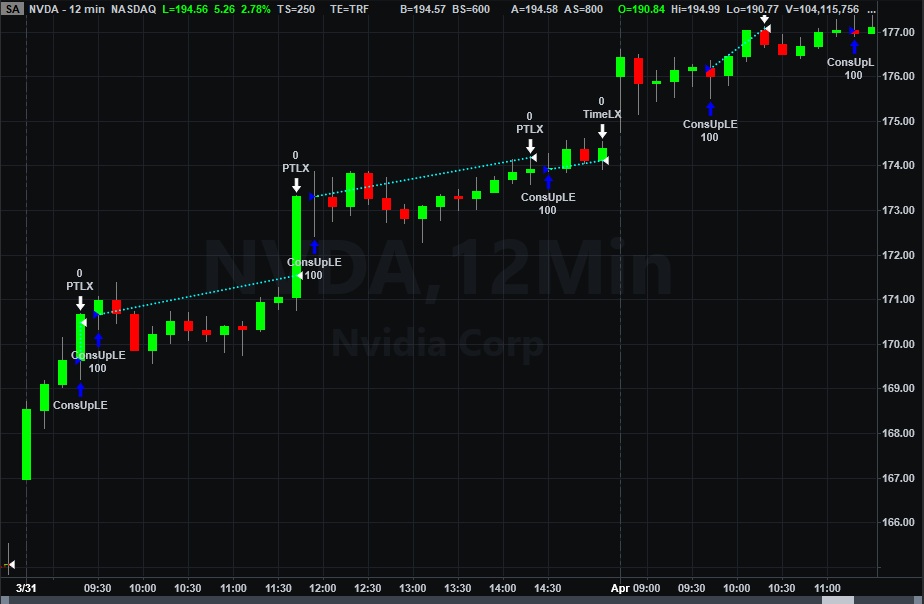
KST Core L2 Features
$19.99 / month
23 Strategies Included!
With this subscription you have access to same strategies as in the Level 1 strategies. The most requested entry filters for custom strategies are available in the Level 2 strategies. As with Level 1 will be able to try these features on your preferred instrument and timeframes. You will also be able to back-test and optimize the strategy. You can use them on as many charts as you like.
Description
Level 2 Features:
- Time Filter: New positions may be filtered by the time of day useful for intra-day trading. These times may be optimized to find the times that may be more profitable for the instrument traded.
- Time Exit: The time exit will close any open position at the specified time of day.
- Reverse: Choose whether an existing position can be reversed with an opposing signal.
- Profit Target: Profit Target using an input as a percentage of the underlying instruments traded.
- Stop Loss: Stop Loss using an input as a percentage of the underlying instrument traded.
- ADX: The ADX must be at a minimum value.
- RSI: The RSI must be OverSold for a long entry and OverBought for a short entry
- ATR: The ATR must be above a minimum level and below a maximum level.
- VWAP: Price must be above VWAP Lower Band for a long entry, and below the VWAP Upper Band for a short entry
- MA: Price must be above the MA for a long entry, and below for a short entry
Day traders use a combination of these five indicators to build a “logic filter” for their trades. Instead of just chasing price, they require multiple indicators to align before entering, which helps them avoid low-probability “noise” and choppy markets.
1. ADX (Average Directional Index)
The Trend Strength Filter
- Avoid Choppy Markets: Traders ignore setups when ADX is below 20-25, as this indicates a ranging market where trend-following strategies often fail.
- Confirm Momentum: Only trades in the direction of the trend are taken when ADX is rising and above 25, ensuring there is enough “fuel” for a move.
2. RSI (Relative Strength Index)
The Overextension Filter
- Avoid Chasing Highs/Lows: Traders pass on long setups if RSI is above 70 (overbought) or short setups if RSI is below 30 (oversold), preventing them from buying at a potential peak.
- Momentum Confirmation: A trade is filtered “in” when RSI moves from an extreme back into the neutral zone, signaling the start of a reversal.
3. ATR (Average True Range)
The Volatility & Risk Filter
- Avoid Illiquid Stocks: A very low ATR relative to price suggests the stock isn’t moving enough to cover commissions or hit a meaningful profit target.
- Dynamic Stop-Losses: Traders use ATR to set stops (e.g., ) to ensure they aren’t “shaken out” by normal market noise while keeping risk strictly defined.
4. VWAP (Volume Weighted Average Price)
The Institutional Benchmark Filter
- Directional Bias: Traders only take longs when price is above VWAP and only take shorts when price is below VWAP, aligning themselves with the day’s “fair value” as seen by major institutions.
- Filter False Breakouts: If price breaks a level but stays on the “wrong” side of VWAP, the trade is discarded as a low-conviction trap.
5. MA (Moving Averages)
The Trend Direction Filter
- Baseline Trend: A common filter is the 9 EMA or 20 EMA; traders only look for entries when the price is trending above these lines in an uptrend, filtering out counter-trend trades.
- Crossovers: Traders may only enter when a short-term MA (like the 9) is above a long-term MA (like the 20), ensuring momentum is aligned across timeframes.